

Sample Chapter: Lack of Institutional Control
Nobody was innocent ... The college was very methodical. They never got their hands dirty. - Greg Claus, former Plattsburgh sports information director

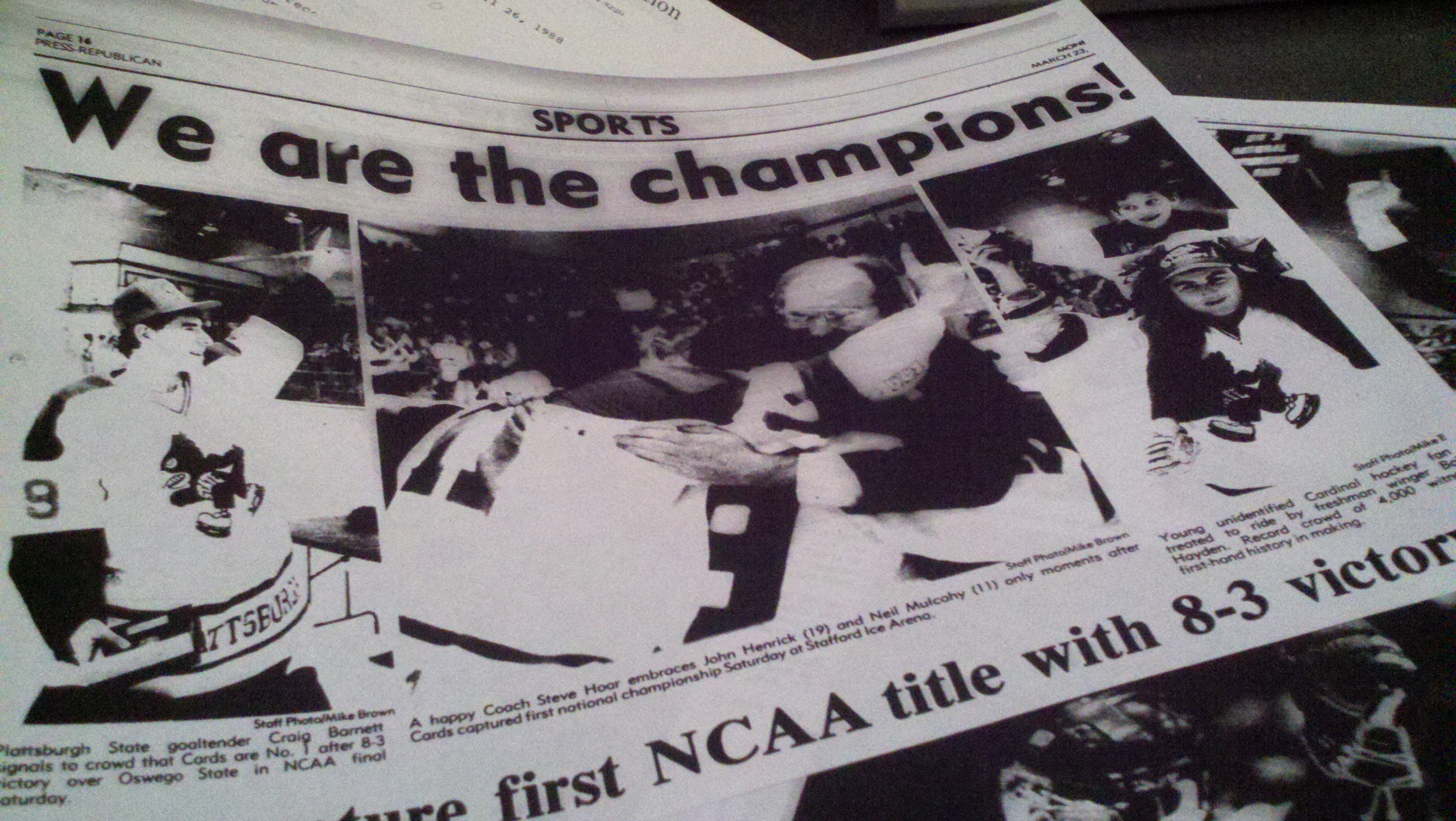
The morning temperatures were in the teens, the daytime high hovered around freezing, and the ashen skies hanging over Plattsburgh, New York, offered no sense of spring, but for the State University of New York at Plattsburgh, a season of change was coming -- fast.
NCAA Director of Enforcement Richard R. Hilliard and the six-person Committee on Infractions released the formal report of violations and subsequent punishment against the college’s ice hockey program. The committee determined that during the period 1985-1988, SUNY Plattsburgh violated multiple NCAA rules in men’s ice hockey.
The investigation concluded:
“… several student-athletes resided in the homes of representatives of the institution’s athletics interests and received impermissible extra benefits. One student-athlete received free housing, occasional meals and small cash loans that resulted in violations of the NCAA extra benefit regulation, as well as an award of financial aid that was contrary to NCAA limitations applicable to Division III members … the committee’s determination that ‘the institution demonstrated a lack of institutional control’ over its men’s ice hockey program … the scope and nature of the findings demonstrate ‘a lack of appropriate institutional control’ and monitoring in the administration of the institution’s intercollegiate ice hockey program during the period in which the violations in this report occurred.” *
“I was working at the Press Republican (Plattsburgh’s hometown newspaper), and I remember the ‘lack of institutional control,’ and thinking to myself, ‘Yeah, no kidding,’” said Greg Claus, former Plattsburgh State sports information director. “That was the sort of brazen attitude that the college had.”
Claus served as the Student Association Information Director (and Sports Information Director) at SUNY Plattsburgh from July 1985 to May 1987. He was hired in July 1987 to cover sports for The Press Republican, the local newspaper. Ironically, he was with the college when the investigation began, and the newspaper that reported the story was there when the violations were announced.
“Nobody was innocent,” said Claus. “Players knew right from wrong. Coaches knew right from wrong. Boosters knew right from wrong. But I think they figured, ‘Hey, I’m helping this kid out, I’m helping him with an apartment, he’s playing on the hockey team …’ The college was very methodical. They never got their hands dirty. When stuff came down – that big ‘lack of institutional control’ – they always painted it as if we (the college administration) didn’t know it was going on. That’s ridiculous. They knew it, and they just didn’t care to monitor it.”
News of the penalties spread far and fast.
“I saw it in USA Today,” said late Plattsburgh State head coach Steve Hoar. “It was shocking and there was a tremendous hurt, a bitterness. It seemed like the school just let down and wanted it to go away at the expense of 25 kids representing SUNY Plattsburgh. I think there is still a tremendous hurt amongst those players if you ask them individually.”
Two months after the NCAA ruling, Doug Bedell, a reporter for the Dallas Morning News, published a 1,500-word story on “the story” at Plattsburgh. The university was getting unwanted nationwide attention. The New York Times and USA Today also published smaller stories on the rise and fall of the Plattsburgh State ice hockey program.
Few people in Plattsburgh saw – or knew – about the story splashed across the front page of the Dallas Morning News on June 3, 1990. By then, few cared, and those who did were no longer connected to the program.
Bedell’s story, peppered with dramatic quotes, innuendo, and factual errors, painted Plattsburgh “as the Twin Peaks of intercollegiate ice hockey intrigue.” A college town on the fringe of Lake Placid, site of “Miracle on Ice” in 1980, when the United States ice hockey team knocked off Russia to win an Olympic gold medal, Plattsburgh was framed as a continuation, a new hockey hotbed.
John Corbett, a former student-athlete at Plattsburgh State, played through the turmoil of the investigation. Corbett, a team captain in 1989, started wearing an SMU baseball cap between periods, as a joke (an athletic program was infamous for being under investigation throughout the 1980s for paying athletes).
“It was like a joke, but that’s where I thought our program was headed,” Corbett told the Dallas Morning News. “It was like a black cloud was hanging over our heads.”
Opposing fans verbally roughed up Plattsburgh wherever they went. Corbett said that when the Cardinals were on the road, fans would chant, “Cheaters State U.!”
“Those charges are ‘perceptions’ by the NCAA,” said SUNY Plattsburgh president Dr. Charles Warren at a press conference following the announcement. “There was a great deal of transition in those years. That may have had something to do with it.

But evidence, including signed affidavits from student-athletes and interviews with boosters, would negate Warren’s claim of “perception” and set the record straight: The administration, leaders of the men’s ice hockey program at SUNY Plattsburgh, and a handful of student-athletes had violated NCAA rules.
Claus became suspicious in the Spring of 1987 while researching potential Academic All-American candidates. “I noticed there were some guys on there, seniors, guys who were juniors and seniors by athletic standing who were sophomores – or even freshmen – by academic standards,” he said.
At the time, Claus wasn’t sure if his findings were violations of an NCAA rule. “I knew that if that stuff wasn’t illegal, it certainly wasn’t ethical. It certainly wasn’t what a Division III college should be involved in. They should be ensuring that these individuals are making progress toward graduation, and it was clear that this was a Division III program in name only. The feeling around there was Division I.”
The State University of New York at Plattsburgh was the first Division III collegiate ice hockey program ever penalized for cheating. The concept of cheating is often measured by the depth and weight of its effects, yet cheating is cheating. It is an act of fraud, dishonesty, deception, or a violation of accepted rules or standards. The story of Plattsburgh’s rise and fall is only dramatic when viewed in its proper context, through the lens of time, place, people, and unprecedented results, both on and off the ice.
It has been debated across Plattsburgh bar tables, diners, and homes for decades now. The violations have been described as harmless, innocuous, and trivial; the math doesn’t add up.
Defenders of the ice hockey program, including former student athletes, coaches, media, boosters, and local supporters, ask how and why. Explain how the laundry list of “incentives” results in vacating a championship, leaving a single asterisk in the NCAA record books? A free bar tab here, a dinner there, a free hockey sticks or puck, a car ride, a service discount – or maybe no cost at all – for housing, how does the judge and jury determine those minor infractions lead to the action taken by the NCAA?
“When they came in and took that NCAA trophy away from them, they took it away from the wrong kids,” said Mike Mannix, former SUNY Plattsburgh play-by-play broadcaster. “That team that won that NCAA tournament was a great team; a good group of guys who had a great year. For somebody to come in a year or two and say, ‘Alright, you’re stripped of it!’ That wasn’t the way to handle it. They could have done something to the administration or the school or something … but to take that title away!? They should have handled it better.”
“I think my biggest concern is that the administration stepped in to see what happened – and yet they were involved,” added Plattsburgh student-athlete Sean Haggerty in a 1990 interview with the Press-Republican. “They keep stressing that everything they did was to help our case; I don’t buy that. You can’t tell me they didn’t know what was going on.”
“They can take away the championship trophy, but they can’t have our rings or the feeling of winning,” said Jamie Ready. “Years from now, we can look back and still know that we were national champions.”
The 1986-87 Plattsburgh State Cardinals won the games and received the NCAA Division III ice hockey trophy, but all that remains in the record books is an asterisk. The record has been wiped clean: Vacated.
“I got calls from an awful lot of players wanting to know if we were going to get a ring,” said former SUNY Oswego head coach Don Unger. “Do we deserve it? You can argue that forever. But when push comes to shove, if you look at the NCAA (record book), there’s one year where there’s no title given, and the team right below that empty spot is us. We think that’s worth something.”
A. The institution shall be publicly reprimanded and censured and placed on probation for a period of two years from the date these penalties are imposed. Further, Plattsburgh State University College shall be subject to the provisions of NCAA Bylaw 19.4.2.3 concerning repeat violators for a period beginning on the effective date of the penalties in this case.
B. During the period of probation, the institution shall report (prior to July 1, 1990; prior to July 1, 1991, and prior to the end of the probationary period) to the NCAA enforcement staff and the Committee on Infractions the actions it has taken to: (1) place its intercollegiate athletics program in general and the men’s ice hockey program in particular under institutional control, and (2) monitor the men’s ice hockey program in a manner that will include, but not be limited to, monitoring of off-campus housing.
C. The institution’s men’s ice hockey team shall end its 1990-91 and 1991-92 seasons with the playing of its last regularly scheduled in-season contest and shall not be eligible to participate in postseason competition following those seasons.
D. The committee has found that, at least in part due to the institution’s failure to exercise institutional control over its men’s ice hockey program, student-athletes who were ineligible to represent the institution (and student-athletes whom the institution’s coaching staff knew or should have known were ineligible) represented the institution in the 1986, 1987 and 1988 National Collegiate Division III Men’s Ice Hockey Championships [reference: Parts II-1-A through F of this report]. Therefore, under the terms of Bylaw 31.2.2.4, the records of the individuals’ and the teams’ performances in those championships shall be deleted.
E. The institution and representatives of its athletics interests shall be prohibited from providing any expense-paid visits to the institution for a prospective student athlete in men’s ice hockey during the 1990-91 academic year.
F. All members of the institution’s men’s ice hockey coaching staff shall be prohibited from engaging in any off-campus recruiting or evaluation activities during the 1990-91 academic year.
Decades have passed since Plattsburgh won its first national championship, but let the record show: the college, the NCAA, community supporters, fans, and administration —just one mention of the investigation still takes their breath away like a cold winter gust off Lake Champlain.

Hi! I’m John Strubel. I am a freelance journalist with a deep passion for storytelling. This blog, and my Substack as a whole, help me scratch my lifelong itch. I hope you enjoy the content and will consider subscribing to my newsletter. Thanks for taking the time to stop by and explore the site.